Fishermen have lots of questions for managers

“I believe that for us to have a healthy fishery we need for fishermen, managers, environmentalists, and marine biologists all to come together and try to resolve fishery management problems. Fishermen are trained to catch fish. Biologists, managers, and environmentalists are trained to save fish. We all need some type of education on how to work for the same goals in fishery management.”
– Captain Rodney Avila
Fishermen are the “first citizens” of the ocean environment. Fishing communities depend on abundant fish stocks and resilient marine ecosystems to thrive, at the same time that fisheries exert significant impact. Inevitably, effective stewardship of marine resources begins with choices made in the wheelhouse and on the pier.
The Marine Resource Education Program (MREP) was founded in 2001 to provide New England fishermen the tools and information to foster an emerging conservation ethic. The guiding objectives of MREP:
- To substantially increase the number of individuals at work in New England fisheries who are comfortable navigating fishery data and management systems.
- To break down historical barriers to cooperation, develop leaders in the fishing industry and fully engage fishermen in the development of “best available science”.
- To deepen the familiarity of policy and science professionals with the workings of the fishing community.
- To bring fishermen, scientists and managers together in a neutral setting to explore differences as well as common goals.

Fishermen-led problem solving, a case study negotiation exercise
– MREP Management Module
Offered twice annually, with over 450 graduates to date in the Northeast Program, the seminars are given in two parts: a three-day Science Module followed by a three-day Management Module. Developed primarily by fishermen for fishermen, the curriculumis structured to lead participants, step-by-step, to a working understanding of fish stock assessments, conservation engineering of fishing gear, ecosystem principles, management process and the skills necessary for effective participation. The program is guided by the MREP board of advisors, in respective regions, with members from across the fishery community, scientists, managers and educators. Seminars are moderated by fishermen trained in meeting management.
Participants are selected from a list of applicants. A typical MREP class will include individuals from the cross-section of fisheries, sectors and ports, junior scientists and managers, US Coast Guard, and environmental organizations.
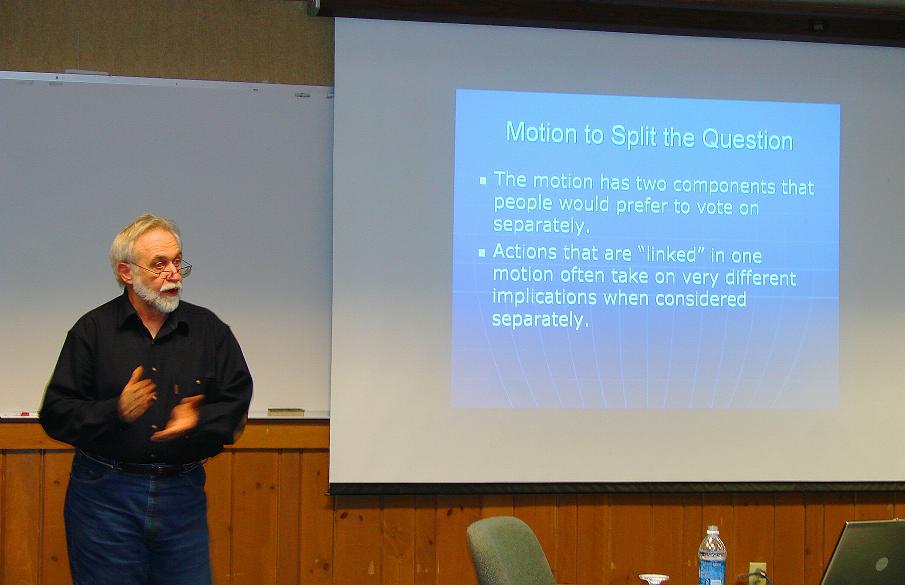
John Williamson teaching a management seminar
The success of this program hinges on sensitivity to the cultural differences that impede communication. The MREP Implementation Team works with content presenters to translate course material into understandable English and to develop novel ways to illustrate complex concepts. The curriculum is consistently evaluated and upgraded for relevance to fishermen. And attention is given to elevating fishermen’s information and knowledge as a primary source of data, building the self-confidence of individuals to effectively contribute to fishery management.
MREP is administered by the Gulf of Maine Research Institute, Portland, ME. Patty Collins (GMRI), Alexa Dayton (GMRI), Libby Etrie (Northeast Sector Service Network), Mary Beth Nickell-Tooley (O’Hara Fisheries) and John Williamson (Sea Keeper Fishery Consulting) serve as the MREP Implementation Team in the Northeast. Mary Beth, John and GMRI staff are co-principals for the MREP concept model with overall responsibility. In 2012-13 the MREP Northeast program expanded to cover fisheries from North Carolina to Maine, with advisors and curriculum team members from Mid-Atlantic fisheries, along with New England Advisors. Alexa is spearheading a subsidiary MREP for fishermen in the Gulf of Mexico/South Atlantic, with a diverse board of advisors from that region; the first MREP Southeast modules will launch in April 2013.
Russell Brown, Deputy Director of the NOAA Northeast Fisheries Science Center discusses the value of MREP here. John Williamson explains the program history and goals here.
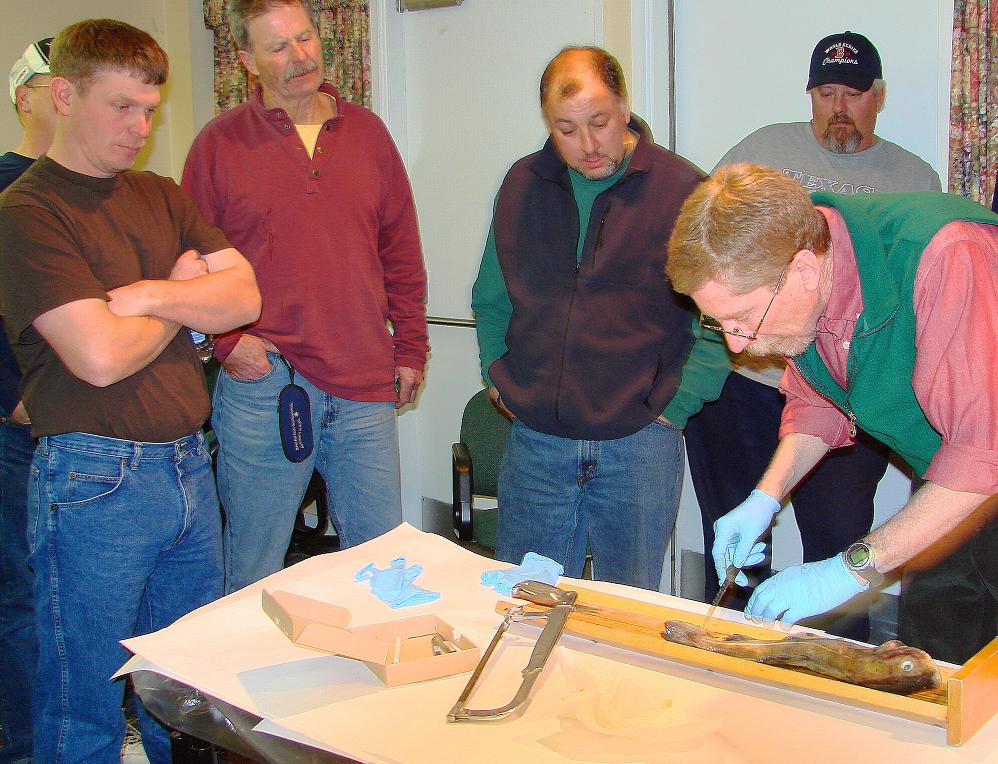
NOAA Fishery scientist demonstrates biological sampling – MREP Science Module
An OIG report to the Senate cited the Marine Resource Education Program as a positive example for NOAA Fisheries: “We heard from industry members and researchers that relationships formed during these seminars provide a foundation that continually supports the ongoing interactions between NOAA and the industry …. these relationships help break down barriers and eliminate preconceptions …” The report concluded that as “more industry members participated in such forums, confidence in fisheries science, understanding of management processes, and relationships with NOAA could improve.”
– Reference: Department of Commerce, Office of Inspector General report to Senators Snowe, Kennedy and Reed; page 15; February 26, 2009.